Cappella Nova - Who are these Angels? - International Record Review
01 May 2012
International Record ReviewRobert Levett
The new recording by
Cappella Nova, one of Scotland's foremost chamber choirs in both early and
contemporary repertoire and which was founded by Alan and Rebecca Taverna 30
years ago, follows on from its earlier release, 'Tenebrae', which was not only
devoted to the music of James MacMillan but included the first set of seven Strathclyde
Motets (Mark Rochester reviewed it in November 2007).
Here we have the
second final set of seven Strathclyde Motets, like the first set named
for the Strathclyde University Chamber Choir but, being genuine liturgical
rather than concert music, written with amateur performance in mind. Also
included are seven further choral pieces and the relatively simple Mass of
Blessed John Henry Newman, written for congregational use and dedicated to
the Most Reverend Mario Conti, Archbishop of Glasgow.
Written between 2007
and 2010, these works represent 'late' MacMillan at his most deceptively
accessible. Homophony, polyphony, antiphony, chant; ornamented solos, hummed
drones, extremes of register and contrasts between soloist and full choir; the
colouristic use of full harp, string quartet and organ: all serve to bring out
the meaning of the text in largely syllabic settings of great clarity. Above
all, this is beautiful, affecting music which is also severely practical.
That being said, to
quote MacMillan from an earlier interview, 'I never want my music to
"preach", and I don't use my music to push some kind of agenda'.
Thus, in the Strathclyde Motets ll, one is, especially listening to them
sitting in the comfort of one's own armchair, drawn to the more abstract
spiritual qualities evoked by the music itself. This is true even when a
section of text is repeated over and over, as with 'Dabit fractum suum' in the
communion antiphon Qui meditabitur, but more so in the gloriously open,
transparent O Radiant Dawn, the gently luminous Lux aeterna, the
delicate antiphonal Os mutorum featuring
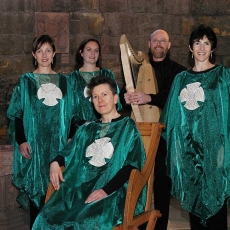
Cappella Nova's offshoot Canty and its harpist William Taylor, and even the
more riven, occasionally strident motets such as Pascha nostrum immolatus
est.
Of the other works, highlights include the
opening piece And lo, the Angel of the Lord, with its wordless humming,
soaring solos and vocal efflorescence, the title track Who are these
Angels?, with its different vocal and string textures and contrasting of a
solo soprano and alto against a male chorus and, finishing the disc in grand
style, the antiphon Tota pulchra es for choir and organ - rich in
syncopations, dissonances and strong dynamic contrasts.
If the
straightforward, attractive Mass sounds workmanlike by comparison, it doesn't
suffer for it; indeed, one of the chief pleasures of listening to it resides in
the ease of imagining taking part in a performance.
As with the earlier
MacMillan release, Cappella Nova under Taverna's direction delivers
performances every bit as luminous and attractive as the music itself. Canty and William Taylor are equally at home
in Os mutorum, as is organist John Kitchen in the Advent Antiphon,
the Mass and Tota pulchra es.
Related Links
Canty
Cappella Nova
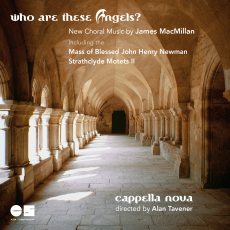
Who are these Angels?