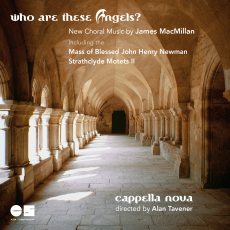
Cappella Nova - Who are these Angels? - Fanfare
Scottish composer James MacMillan (b.1959) has written music for all levels of choirs throughout his career, but since 2004 he has produced a particularly large number of works specifically "designed for a good, amateur church or cathedral choir, or amateur secular choir." Of course, this refers to an "amateur" choir by British standards. Due to the vastly different choral standards, most of these works would hardly prove easy for a typical American chorus. MacMillan has grouped many of these pieces under the heading Strathclyde Motets , so named because many were written for the choral ensembles at Strathclyde University, under the direction of Alan Tavener. A lifelong devout Roman Catholic, MacMillan was asked in 2005 to accept a post as music director for a small Dominican parish near Glasgow. No doubt his weekly work as a church choir director inspired him to compose a number of these liturgical pieces.
I have written before on numerous occasions that I believe MacMillan to be one of the most compelling voices of our time, with a personal musical language that draws deep on a rich musical past to forge an intensely expressive musical present. Though his dazzling orchestral scores have won him great acclaim, what he achieves in these sacred choral works (most intended for liturgical performance) is no less great, and I believe places him in a truly select company of the absolute finest composers in the entire history of the art form.
These two superb choral releases collect most all of MacMillan's shorter choral offerings from the last decade. There are so many gems here that it's hard to know where to begin in describing them. Both discs focus on a sampling of motets from the 15 that make up the Strathclyde cycle. (Neither disc presents the cycle complete, nor is every motet covered even between the two discs.) The other items range from the absolutely stunning large-scale Miserere (2009) to the ebullient and unexpectedly dance-like Tota pulchra es, from the simple and heartbreakingly beautiful Think of How God Loves You to the congregational Mass of Blessed John Henry Newman (2010), written for the papal visit to the United Kingdom and the Mass celebrating Newman's beatification. The most popular of these pieces (though many are quite new) is the glorious O Radiant Dawn (one of the only Strathclyde Motets in English), which has already been taken up by a number of American choirs.
Though several of the Strathclyde Motets overlap between the two discs, that is hardly a reason not to acquire them both. Both discs are excellently performed.
Fanfare
05 February 2012