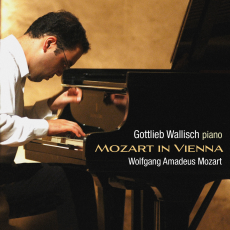
Gottlieb Wallisch - Mozart in Vienna - The Consort
01 June 2011
The ConsortMartin Jones
It is fascinating to
hear the piano music that Mozart composed during his last ten years in Vienna,
from 1781 until his death in 1791, played by a Viennese pianist of about the same
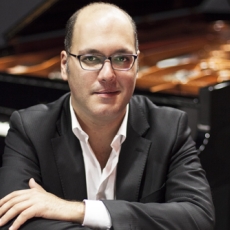
age. Gottlieb Wallisch has appeared at renowned international festivals,
including our own Newbury Spring Festival, and broadcasts regularly on radio in
many countries.
By concentrating on
Mozart's Vienna years, when he was breaking free from the patronage that had
supported him, in order to seek his own success with the Viennese public,
Wallisch has assembled a varied programme of piano styles: the last two sonatas (K750 and K576), a
Fantasy (K397), a Rondo (K511) and a set of variations (K455) on an operatic
aria of Gluck.
The recital was
recorded in St George's, Bristol: an acoustic which allows Wallisch's
expressive playing space to breathe without losing intimacy. His excellent
programme notes in the CD booklet explain, in English and in German, the
historical context of each piece and, particularly in the case of the two
sonatas, their significant position in Mozart's creative development.
Mozart wrote almost
half of his compositions for piano during this decade in Vienna. Commenting on
the two sonatas, no.17 in B flat major (K570) and no.18 in D major (K576),
Wallisch observes that these two late works illustrate the concern of late
18th-century composers to achieve an integration between the earlier polyphonic
style of keyboard writing, with its complex counterpoint, and the contemporary galant
style.
In 1782, Mozart's
Viennese friend, Gottfried van Swieten, had introduced the young composer to
the works of Bach and Handel, and Mozart continued to study them. The results of
his study of these great baroque masters can be seen in sonata no.17, in which
Mozart develops the thematic material of the first movement in double
counterpoint, while sonata no.18 resembles a Bach suite in its two-part
texture. Thus, towards the end of his life, Mozart achieved an integration of
older and newer styles of keyboard composition.
Related Links
Gottlieb Wallisch
Mozart in Vienna