Magnificat - Philippe Rogier - Audio Visual Club of Atlanta
Philippe Rogier (1561-1595) was a native of Flanders who went to Madrid as a chorister in the service of King Philip II of Spain in 1572 and remained there the rest of his life. In 1586 he became Maestro de Capilla, head of the musical establishment at the Escorial, the magnificent combination of royal palace, monastery, library, basilica, seminary and mausoleum that remains today as a monument to the Siglo de oro, the Golden Age of Spain. Though many of the 250 compositions Rogier wrote during his brief life perished in a fire at the royal palace and the Lisbon Earthquake of 1755, enough has remained to rate this composer as one of the lights of the 16th century. Rogier embodied both the best of flowing Flemish counterpoint and the new polychoral music that emanated from Italy.
The present program displays attractive examples of Rogier's art in two of his Masses, the twelve-part Missa Domine Dominus Noster (Oh Lord, our governor, how excellent is Thy Name in all the world) and the Missa Domine in Virtute tua (The King shall rejoice in thy strength). The latter is a "parody" Mass, a type of composition in which one composer paid homage to another by borrowing material from him. In this case, it was an eight-part motet of the same name by Palestrina, Rogier's great contemporary in Rome, which is included in the present program for comparison. Rogier's Mass shows affinity to Palestrina in the wonderful freedom in the vertical dimension that its advanced polyphonic technique afforded the composer. His genius shows itself most readily in the Credos of both Masses, where he avoids the turgidity that often afflicts settings of this time-honored declaration of faith by keeping things "spinning" (Cave's own metaphor). Rogier's final Amens in the Gloria and Credo of both Masses have a luxuriance that intensifies the other-worldly quality of his music.
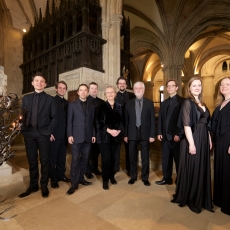
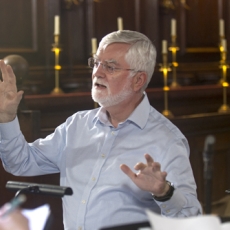
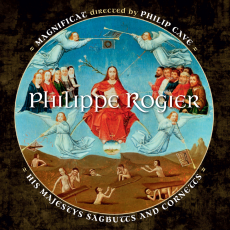
This quality in the music of Rogier's time is clearly not a part of the world of music we know today. Therefore, Philip Cave and the 17 SATB voices he has at his disposal in the vocal ensemble Magnificat are at pains to re-create this music, through careful research into its characteristic style and the ethos that supported it. Their pitch, phrasing and voice-leading are flawless, as they must be in order to convey the essential quality of this genre of music. In that regard, they are assisted by the members of His Majestys Sagbutts and Cornetts, an ensemble that includes harp, lute, dulcian and organ in addition to the afore-mentioned instruments. By tastefully enriching and illuminating the harmony of Rogier's eight-part and 12-part vocal writing, they reinforce its glowing qualities.
Audio Visual Club of Atlanta
01 June 2011