

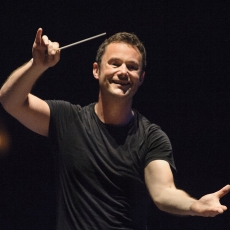
Matthew Halls - Live Review - Oregon Festival - Denver Post
It is not hard to understand why the artistic leadership of Central City Opera decided to take a chance on the virtually unknown opera "Amadigi di Gaula": The music is simply stunning.
Especially memorable are its succession of lovelorn arias — slow, deeply poignant expressions of the heartbreak that each of the opera's four main characters feels at different points in this story of intertwined, sometimes jealous romantic passions.
"Amadigi," which premiered in London in 1715 but later fell out of favor, is one of 49 operas written by George Frideric Handel , who is best known as the composer of the celebrated Christmas-Easter oratorio, "Messiah."
Handel was not just one of the leading voices of the baroque era — roughly 1600 to 1750 — but he also stands as one of the greatest composers of all time.
But because of the vagaries of musical tastes and fashion, his operas fell into obscurity until the middle of the 20th century, and it was not until the 1980s and '90s that companies began reviving his works in earnest.
Central City's production of "Amadigi," which opened Saturday, is the work's American stage premiere — a significant milestone both in Handel's continuing operatic comeback and the company's rich history of adventurous programming.
It is worth attending this production just to hear the score. It is brought vividly and organically to life by conductor Matthew Halls, who outdoes himself in his third appearance with the company, and a first-rate pit orchestra supplemented by four baroque specialists.
Many fine individual performers stand out, including Patrick Jones, harpsichord; Madeleine Owen and Matthew Wads- worth, theorbo and baroque guitar; and Jeffrey Stephenson, oboe.
If the appealing music makes clear why Central City is debuting "Amadigi," the work's scant plot explains why other companies probably did not do it sooner.
Like many baroque operas, the emphasis in "Amadigi" is on arias and not action, and, at least in this version, it becomes repetitive at times.
The plot is a kind of love square. The sorceress, Melissa, does everything in her power to keep Amadigi and Oriana apart in a failed attempt to take him for herself. Meanwhile, Amadigi's best friend, Dardano, pines for Oriana.
In an understandable attempt to enliven the narrative, stage director Alessandro Talevi has set the story in a kind of Renaissance cabinet of curiosities (designed by Madeleine Boyd), with Oriana's fantastical appearance in Act 1 clearly inspired by Sandro Botticelli's painting "The Birth of Venus."
While this approach does provide provocative visuals, the complex scenery goes too far and winds up overpowering and overburdening the story, with the often packed stage seeming claustrophobic at times.
Talevi does, however, succeed in drawing strong, compelling performances from the principal singers, with the exception of countertenor David Trudgen. Though effective vocally, he appears ill at ease on stage and is underwhelming in the role of Dardano.
The production's clear standout is soprano Katherine Manley, who is making her American debut in the role of Oriana.
She has all the makings of a star, including a commanding stage presence and a fresh, spellbinding voice. Caressing every word and digging into its deepest emotions, she assures that Oriana's Act 1 love aria is one of the opera's highlights.
Nicely balancing her is countertenor Christopher Ainslie, who is also making his American debut. He brings dramatic weight to the title role and skillfully and expressively handles its complex vocal demands.
Rounding out the main cast is soprano Kathleen Kim as Melissa. Capitalizing on her big, gleaming voice, she makes the most of her role as the opera's villainess.
Denver Post
06 July 2011