Produced by
Andrew Keener
Recorded on 22nd & 23rd February 2004 at the Usher Hall, Edinburgh.
Engineered by Calum Malcolm
Post Production by Julia Thomas at Finesplice, UK
Photo of Joseph Swensen by Douglas Robertson
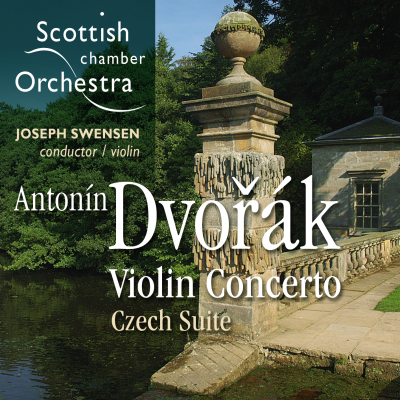
There is a story, related by one of the composer’s pupils after his death, that Dvorak preferred his Violin Concerto to his great B minor Cello Concerto. While the Violin Concerto certainly justifies its role as a much-loved constituent of the repertoire, the judgement of history has favoured the ‘Cello Concerto, which is now one of Dvorak’s two most popular orchestral works. His preference for the violin concerto may have had much to do with his notorious mistrust of the timbre of the cello (‘thin on top and grumbling in the bass’); it may also reflect Dvorak’s own instrumental expertise since he was a good viola player and, when occasion demanded, an able violinist.
Dvorak wrote the Violin Concerto during the summer of 1879 as his reputation was fast acquiring its international dimension. Along with a large admiring public, Dvorak now found himself in the company of such luminaries as Brahms and his violinist friend, Joseph Joachim. An inscription on a sketch for the Violin Concerto, made in July 1879, indicates that Dvorak intended it for Joachim. At the end of the same month, Dvorak visited him in Berlin and presumably discussed his new concerto. A version of the concerto was completed later that summer, but this was far from being the end of the story. Joachim recommended numerous revisions which Dvorak, an almost compulsive reviser of his own works, undertook meticulously. While it is not possible to assess the full extent of these revisions since Dvorak destroyed the original material, it is clear from a letter that the changes were very far reaching touching every aspect of the concerto’s musical fabric and organisation.
Even these alterations were not enough for Robert Keller, a much valued adviser of Dvorak’s publisher Simrock, who wanted the composer to write a new ending for the first movement rather than letting it lead straight into the slow movement. For Dvorak, who was usually receptive to Keller’s suggestions, the time for accommodation was past, and he refused to make this change, not least, perhaps, because the passage linking first and second movements is one of the loveliest in the concerto. Simrock accepted his judgement and in 1883, four years after its completion, the Concerto was published. It is interesting to reflect that Joachim may have been in agreement with Keller since he never performed the work at a public concert, though he had run through it in a fairly full orchestral rehearsal in Berlin; the premiere was given in 1883 by Dvorak’s friend the violinist František Ondøíèek.
Even by Dvorak’s standards, the concerto is a richly lyrical work. The first movement begins boldly with a forceful unison statement from the orchestra answered by a bitter-sweet melody from the solo violin. Another exchange between solo and orchestra, and a cadential flourish lead into the main part of the movement in which the violin is rarely silent. A miniature cadenza initiates the exquisitely crafted link into the slow movement whose rapt melodic lines are interrupted by a stormy minor-key central episode - a direct anticipation of the slow movement of the cello concerto composed sixteen years later. The finale is close to the world of the “Slavonic Dances” and the “Czech Suite”. The main theme is imbued with the cross-rhythms of the Czech Furiant and provides the frame for a number of memorable episodes, including a reflective D minor interlude, before the exhilarating end.
The Nocturne in B major is something of a ‘time-traveller’ in Dvorak’s output. Over a period of some fourteen years, it appeared in as many as five guises. It began life as the slow section of one of Dvorak’s most experimental works, the string quartet in e minor (B 19) from the late 1860s. This astonishing work is cast in a single movement lasting some forty minutes; the music that became the Nocturne provides a gentle interlude in a bold, often tumultuous, exploration of contemporary tonality. While Dvorak made no attempt to rescue the main part of the quartet through revision, he salvaged the slow section and used it as the first slow movement of the ‘Double Bass’ string quintet of 1875. Proving to be rather too much of a good thing, this extra slow movement was dropped and the Nocturne achieved independence in versions for piano four hands, violin and piano, and for string orchestra possibly as late as 1883. In this version for strings, either solo or orchestral, the Nocturne is an attractive occasional piece, richly textured with affecting harmonies set over a sustained pedal bass note.
Dvorak’s best known piano music, in the shape of the “Slavonic Dances” and “Legends”, are duets, but he also wrote numerous collections of pieces for two hands. One of these was a group of Eight Waltzes composed late in 1879 and the first two weeks of 1880. Later that year, for a concert of his own promotion, Dvorak arranged two of the dances, the first and fourth, for string orchestra. The first, in A major, is amiable and relaxed, although a more plaintive mood is struck in the slightly brisker Trio.
03 January 2012
Scotland
Dumfries Easterbrook Hall, Dumfries
New Year in Vienna
There is no better way to welcome in 2012 than with an uplifting Viennese New Year concert featuring favourite waltzes and polkas from the Strauss Family.
A night in Old Vienna, including:
J STRAUSS: Overture, Die Fledermaus
J STRAUSS II: Kunstlerleben (Artists' Life) Waltz
LEHAR: Gold and Silver Waltz
J STRAUSS II: Champagne Polka
Nicholas McGegan, conductor
Elena Xanthoudakis, soprano
7pm
04 January 2012
Scotland
Ayr Town Hall, Ayr
New Year in Vienna
There is no better way to welcome in 2012 than with an uplifting Viennese New Year concert featuring favourite waltzes and polkas from the Strauss Family.
A night in Old Vienna, including:
J STRAUSS: Overture, Die Fledermaus
J STRAUSS II: Kunstlerleben (Artists' Life) Waltz
LEHAR: Gold and Silver Waltz
J STRAUSS II: Champagne Polka
Nicholas McGegan, conductor
Elena Xanthoudakis, soprano
7pm
05 January 2012
Scotland
Perth Concert Hall, Perth
New Year in Vienna
There is no better way to welcome in 2012 than with an uplifting Viennese New Year concert featuring favourite waltzes and polkas from the Strauss Family.
A night in Old Vienna, including:
J STRAUSS: Overture, Die Fledermaus
J STRAUSS II: Kunstlerleben (Artists' Life) Waltz
LEHAR: Gold and Silver Waltz
J STRAUSS II: Champagne Polka
Nicholas McGegan, conductor
Elena Xanthoudakis, soprano
7pm
17 January 2012
to
17 January 2012
Scotland
St Cuthberts Parish Church (6pm), Edinburgh, Scotland
CL@6: A Day In Symphonies
27 January 2012
Scotland
City Halls, Glasgow
Aimard Plays Brahms
Pierre Laurent-Aimard perfoms Brahms' mighty Piano Concerto No 2, in a concert also featuring music by Haydn and Ligeti.
Programme:
HAYDN: Symphony No.22 in Eb 'Philosopher'
LIGETI: Chamber Concerto for 13 Instruments
BRAHMS: Piano Concerto No.2
Robin Ticciati, conductor
Pierre-Laurent Aimard, piano
7.30pm
02 February 2012
Scotland
Queen's Hall, Edinburgh
Langree Conducts Beethoven
Louis Langrée directs the SCO and a world-class line-up of soloists in Beethoven's magnificent Mass in C.
Programme:
GLUCK: Overture, Iphigenie en Aulide
BEETHOVEN: Symphony No.4
BEETHOVEN: Mass in C
Louis Langree, conductor
Elena Xanthoudakis, soprano
Jurgita Adamonyte, mezzo soprano
Andrew Staples, tenor
Alastair Miles, bass
SCO Chorus
7.30pm
03 February 2012
Scotland
City Halls, Glasgow
Langree Conducts Beethoven
Louis Langrée directs the SCO and a world-class line-up of soloists in Beethoven's magnificent Mass in C.
Programme:
GLUCK: Overture, Iphigenie en Aulide
BEETHOVEN: Symphony No.4
BEETHOVEN: Mass in C
Louis Langree, conductor
Elena Xanthoudakis, soprano
Jurgita Adamonyte, mezzo soprano
Andrew Staples, tenor
Alastair Miles, bass
SCO Chorus
7.30pm
05 February 2012
Scotland
Queen's Hall, Edinburgh
Chamber Concert
Pianist Llyr Williams is joined by SCO Principals, Maximiliano Martín and Jane Atkins, for a Sunday afternoon treat of music by Brahms and Kurtág.
Programme:
BRAHMS: Sonata Op 120 No.1 in F minor
BRAHMS: Intermezzi
KURTAG: Hommage a R. Schumann
BRAHMS: Sonata Op 120 No.2 in Eb
Llyr Williams, piano
Maximiliano Martin, clarinet
Jane Atkins, viola
3pm
09 February 2012
Scotland
Usher Hall, Edinburgh
Emperor and Eroica
Andrew Manze conducts two masterworks by Beethoven, with Llyr Williams the soloist in Beethoven's Piano Concerto No.5
Programme:
CHERUBINI: Overture, Demophoon
BEETHOVEN: Piano Concerto No.5 'Emperor'
BEETHOVEN: Symphony No.3 'Eroica'
Andrew Manze, conductor
Llyr Williams, piano
7.30pm
10 February 2012
Scotland
City Halls, Glasgow
Emperor and Eroica
Andrew Manze conducts two masterworks by Beethoven, with Llyr Williams the soloist in Beethoven's Piano Concerto No.5
Programme:
CHERUBINI: Overture, Demophoon
BEETHOVEN: Piano Concerto No.5 'Emperor'
BEETHOVEN: Symphony No.3 'Eroica'
11 February 2012
to
11 February 2015
Scotland
Aberdeen Music Hall, Aberdeen,Scotland
Emperor and Eroica
Union Street Aberdeen AB10 1QS
23 February 2012
to
23 February 2012
Scotland
City Halls, Glasgow, Scotland
Serenade
Candleriggs, Glasgow G1 1NQ
28 February 2012
to
28 February 2012
Scotland
St Cuthberts Parish Church, Edinburgh, Scotland
CL@6: A Lark Ascending
Lothian Road, Edinburgh EH1 2EP - 6PM
29 February 2012
to
29 February 2012
Africa
Younger Hall, St Andrews, Scotland
Early Evening Concert
North SAtreet, St Andrews KY16 9JA - 5.30PM
12 April 2012
to
12 April 2012
Scotland
Queen's Hall, Edinburgh, Scotland
Baroque Greats
13 April 2012
to
13 April 2012
Scotland
City Halls, Glasgow Scotland
Baroque Greats
Candleriggs, Glasgow G1 1NQ
20 April 2012
to
20 April 2012
Scotland
City Halls, Glasgow, Scotland
A Cold Spring
Candleriggs, Glasgow G1 1NQ
25 April 2012
to
25 April 2012
Scotland
Ayr Town Hall, Ayr, Scotland
Benedetti: Vivaldi's Four Seasons
26 April 2012
to
26 April 2012
Scotland
Usher Hall, Edinburgh, Scotland
Benedetti: Vivaldi's Four Seasons
27 April 2012
to
27 April 2012
Scotland
City Halls, Glasgow, Scotland
Benedetti: Vivaldi's Four Seasons
Candleriggs, Glasgow G1 1NQ
03 May 2012
to
03 May 2012
Scotland
Queen's Halls, Edinbugh, Scotland
Biss PLays Mozart
04 May 2012
to
04 May 2012
Scotland
City Halls, Glasgow, Scotland
Biss Plays Mozart
10 May 2012
to
10 May 2012
Scotland
Usher Hall, Edinburgh, Scotland
Beethoven's Choral Symphony
11 May 2012
to
11 May 2012
Scotland
City Halls, Glasgow, Scotland
Beethoven's Choral Symphony