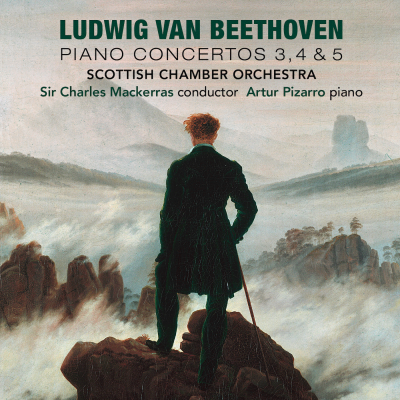
Beethoven Piano Concertos 3, 4 & 5
When Beethoven wrote a set of three works such as violin sonatas or string quartets he normally gave them strongly contrasting characters. Although his last three piano concertos were not created as a set, but spanned about a decade in their composition, they nevertheless exhibit a similar level of contrast. No.3 is stormy and agitated; No.4 is gentle and lyrical; and No.5 is grand and majestic - so much so that in English-speaking countries it has gained the nickname ‘Emperor'. Thus they could hardly be more different in mood, yet each one in its own way is thoroughly characteristic of the composer.
One of Beethoven's earliest sketches for Piano Concerto No.3 dates from about 1796 and shows him already experimenting with new sonorities, with a prominent motif being allocated to the timpani part - which normally played a merely accompanying role in orchestral music at the time. However, little progress was made on the work until 1800, when it was taken up in preparation for a concert that April. Unfortunately it was not ready in time and Beethoven had to substitute a different concerto (probably No.1). He did not finally complete No.3 until 1803, and at its first performance that year he had to play the piano part largely from memory as he had still not had time to write it out in full. His page-turner at the première, Ignaz von Seyfried, reports of having to turn pages that were largely blank apart from a few hieroglyphs that only Beethoven could read!
Although the first movement is stormy in character it has a beautifully lyrical second subject; Beethoven cunningly transformed this theme almost beyond recognition to form the main theme of the sublime slow movement. This evokes a completely different and more exalted world, in the remote key of E major, with a reduced orchestra and muted strings. The key of C minor returns in the finale, but there is one brief excursion back to E major, as if recalling that exalted world; and the music ends in a blaze of glory, in a triumphant C major.
Piano Concerto No.4 breaks with all previous tradition by beginning with solo piano instead of the usual extended orchestral ritornello. This unexpected opening signals that the relationship between piano and orchestra will be closer than normal; and although the orchestra quickly takes over for its customary ritornello, this does not conclude with the usual cadence but breaks off in mid-phrase, with the piano re-entering quietly in contrast to its dramatic entrance in No.3.
The slow movement is unusually brief, and scored just for strings and piano, which engage in a dramatic dialogue throughout. Initially the strings sound angry, but the gentle pleading of the piano gradually softens them until they die away to a hushed pianissimo. The similarity to the ‘Taming of the Furies' by Orpheus is unmistakable, and has led many to assume that this is what Beethoven was attempting to portray. Yet there is no reference to Orpheus in anything written or said by Beethoven about the movement, and it seems unwise to narrow the music down to a single myth; better, surely, to regard the music as emblematic of all situations where anger is calmed by gentleness - of which Orpheus and the Furies form just one instance.
One factor that makes the first two movements of this concerto particularly tender is the absence of trumpets and drums. In the finale, however, these finally burst in and create a sense of much greater exuberance, although there are still many gentler passages that remind us of the mood of the rest of the work.
Although the concerto was composed mainly in 1806 it had to wait until December 1808 for its public première - at a four hour all-Beethoven concert. On that occasion Beethoven played the concerto very ‘mischievously' according to his pupil Carl Czerny, adding many more notes than were printed, and sketchy indications of these extra notes are found in one of Beethoven's manuscripts. Nevertheless the work has become known, like No.3, in its printed version, with the only addition in both cases being cadenzas that Beethoven composed in 1809 for another of his pupils, Archduke Rudolph.
The success of the 1808 concert may have induced Beethoven to begin another concerto almost immediately, early in 1809. Increasing deafness, however, meant that he was never to play Piano Concerto No.5 in public; and although he began a Sixth Piano Concerto in 1815, he composed only part of the first movement before laying it aside.
In the Fifth, Beethoven again breaks with tradition by introducing the piano very early, but this time to provide ornate decoration to three emphatic orchestral chords before the main theme gets under way. The second subject is heard first in the minor but then reappears transformed in the major, and is later heard sounding like a majestic march. In this form it is accompanied by just two alternating chords, so that the two timpani between them can play the entire bass line (if the music is in the right key). Therefore, as in the Third Piano Concerto, Beethoven gives the timpani an important part to play.
Another feature that recalls the Third Concerto is that the theme of the slow movement is again a disguised version of the second subject of the first movement - that march theme is now transformed into a serene, hymn-like melody. Again, Beethoven uses a remote key - this time B major - and omits the trumpets and timpani. The music eventually modulates back to E flat, with a tentative hint of the theme of the next movement, thus providing a seamless join to the finale. Here the theme is announced by the piano before being taken up by the orchestra. The main bass line for this theme uses only two notes - the same two as in the march theme in the first movement - and so it can again be played in its entirety by the timpani. Even in the final coda the timpani have an important part to play, in an extraordinary passage for just solo piano and timpani, where the latter pick up an accompanying figure that had previously been played only by other instruments. Beethoven's remarkable level of invention, whether of thematic manipulation, key relationships or orchestration, remains in evidence right to the very end.
© Barry Cooper, 2009
Recording information:
Recorded at Perth Concert Hall, UK from 2nd - 5th November 2008
Produced by James Mallinson
Engineered by Philip Hobbs
Post-production by Julia Thomas, Finesplice, UK
Piano technician Bruno Torrens - Artur Pizarro plays a Bluthner concert grand piano supplied courtesy of the Bluthner Piano Centre, London - www.bluthner.co.uk
Design by John Haxby (Art Surgery)
Cover image courtesy of AKG Images: 'Der Wanderer über dem Nebelmeer' (The Wayfarer above a Sea of Fog) c.1818. Caspar David Friedrich (1774-1840). Kunsthalle, Hamburg.
Klassik.com'...fast transzendente Musizieren ein...'
more >>Gramophone"...a performance of grace and musicianly charm."
more >>HMV Choice
"Pizarro makes the music drift and glide throughout..."
more >>FonoForum"Bereits nach den ersten Tönen überrascht der warme, volle Klavierklang der CD..."
more >>Politiken"Men spillet er i øvrigt dejlig klart..."
more >>Politiken (translation)"...the playing is overall beautifully clear..."
more >>Classical Source"...this release is mandatory."
more >>Keswick Reminder"...[a] fine collaboration..."
more >>Classic FM Magazine
"...dedicated performances..."
more >>SACD.net
"Everything seems to be right here..."
more >>Opus Musica"...gran música en excelentes condiciones."
more >>International Record ReviewIRR Outstanding: "...nearly two hours of unalloyed delight."
more >>Audiophile Audition
"...the results are sterling. Warmly recommended..."
more >>MusicWeb International"...this is a wonderful issue."
more >>The Herald
"...electric and integrated Beethoven performances. A great set..."
more >>Audio Video Club of Atlanta"...there's a real verve and a reveling in the ambiance of gorgeous musical sounds..."
more >>The Scotsman
"...the overall impression is of unanimous intention and glorious teamwork."
more >>BBC Online"...multi-faceted and magnificent..."
more >>Sunday Herald"outstanding performances, always satisfying and frequently inspiring."
more >>Sempre Audio"Die Audioqualität ist in jedem Fall überragend und sowohl in Stereo als auch Surround atemberaubend."
more >>Musical Pointers"This must be one of the very best..."
more >>BBC Music Magazine
"the recorded sound is ideal."
more >>
19 February 2013
to
19 April 2013
Scotland
City Halls, Glasgow, Scotland, UK
Sco and SCO Chorus
13 March 2013
to
13 March 2013
Scotland
Younger Hall, St Andrews, Scotland, UK
Das Lied von der Erde
15 March 2013
to
15 March 2013
Scotland
City Halls, Glasgow, Scotland, UK
Das Lied von der Erde
16 March 2013
to
16 March 2013
Northern Ireland
Queen's Hall, Edinburgh, Scotland, UK
Das Lied von der Erde
20 March 2013
to
20 March 2013
Scotland
Younger Hall, St Andrews, Scotland, UK
Early Evening Concerts 2012/13 - March
04 April 2013
to
04 April 2013
Scotland
Usher Hall, Edinburgh, Scotland, UK
Ticciati conducts Berlioz
04 April 2013
to
04 April 2013
Scotland
Queen's Hall, Edinburgh, Scotland, UK
SCO
05 April 2013
to
05 April 2013
North America
The Granada Theatre, University of Calafornia Santa Barbara USA
USA Tour - Programme 1
05 April 2013
to
05 April 2013
Scotland
City Halls, Glasgow, Scotland, UK
Ticciati conducts Berlioz
07 April 2013
to
07 April 2013
North America
Walt Disney Concert Hall, Los Angeles USA
USA Tour - Programme 1 Santa Barbara
10 April 2013
to
10 April 2013
Scotland
Dumfries Easterbrook Hall, Dumfries, Scotland, UK
Sinfonia Concertante
11 April 2013
to
11 April 2013
Scotland
Queen's Hall, Edinburgh, Scotland, UK
Sinfonia Concertante
12 April 2013
to
12 April 2013
Scotland
City Halls, Glasgow, Scotland, UK
Sinfonia Concertante
12 April 2013
to
12 April 2013
North America
St Mark's United Methodist Church, Indialantic USA
USA Tour - Programme 1
14 April 2013
to
14 April 2013
Scotland
Eden Court Theatre, Inverness, Scotland, UK
Sinfonia Cocertante
18 April 2013
to
18 April 2013
Scotland
Queen's Hall, Edinburgh, Scotland, UK
Britten 100:1
19 April 2013
to
19 April 2013
Scotland
City Halls, Glasgow, Scotland, Uk
Britten 100:1
19 April 2013
to
19 April 2013
North America
Foellinger Great Hall - University of Illionois, Urbana-Champaign Illionois USA
USA Tour - Programme 1
21 April 2013
to
21 April 2013
Scotland
Queen's Hall, Edinburgh, Scotland, UK
Chamber Concert
24 April 2013
to
24 April 2013
Scotland
Younger Hall, St Andrews, Scotland, UK
Britten 100:11
26 April 2013
to
26 April 2013
Scotland
City Halls, Glasgow, Scotland, UK
Britten 100:11
27 April 2013
to
27 April 2013
Scotland
Queen's Hall, Edinburgh, Scotland, Uk
Britten 100:11
02 May 2013
to
02 May 2013
Scotland
Usher Hall, Edinburgh, Scotland, UK
Beethoven Seven
03 May 2013
to
03 May 2013
Scotland
City Halls, Glasgow, Scotland, UK
Beethoven Seven
09 May 2013
to
09 May 2013
Scotland
Queen's Hall, Edinburgh, Scotland, UK
Levin plays Mozart
10 May 2013
to
10 May 2013
Scotland
City Halls, Glasgow, Scotland, UK
Levin plays Mozart