Booklet notes:
Paris 1778 After a long trip with sojourns in Munich, Augsburg and Mannheim, the young composer W. A. Mozart finally arrived in the city on the Seine. He had left his hated service in Salzburg, hoping now for a well-paid position. This hope was not to be fulfilled in Paris, but at least he re-encountered his important compositional role model, Johann Christian Bach. Mozart had already performed with him as an 8-yearold in London and his musical style was strongly recommended for imitation by his father Leopold Mozart.
No wonder the three sonatas K. 330-332 were long considered to belong to the ‘Paris Sonatas', since they bear - like so many of Mozart's compositions - the unmistakable stylistic stamp of the great son of J. S. Bach. However, a paper analysis of resourceful musicologists showed that these three works were actually created in Salzburg years later in 1783. Mozart had these sonatas published in 1784 by the Viennese music publisher Artaria as ‘Opus VI'. None of the autographs have been retained in their entirety, but it appears that the first edition was revised by Mozart himself, as it contains more dynamic indications than the existing manuscripts.
Mozart left 18 piano sonatas in total; they account for nearly one-sixth of the 102 piano works registered in the Köchelverzeichnis. It took Mozart five long years after writing the Sonata K. 310 in 1778 to revisit the genre with K. 330. These were formative years for the young composer; his beloved mother had passed away in Paris and he had freed himself from the influence of his all powerful father, who was not pleased that after Aloysia Weber's betrayal, Mozart had married her younger sister Constanze.
Despite - or perhaps, because of - these circumstances, the Sonata in C Major is cheerfully coloured and life-affirming, simply and economically designed, full of grace with its ideas freely and homogeneously intertwined. The slow movement's middle section in F minor is melancholic and profound, and the finale appears with the clean sweep of a contredanse.
K. 332 can almost be regarded as a twin: there's hardly any thematic work and it's brimming with musical ideas. The Allegro's development has very little motive growth; the Adagio is artfully delicate, in the gallant style so very reminiscent of J. C. Bach. The virtuoso finale is technically quite demanding for the pianist, unusual for that time as the sonata was mainly regarded to serve an educational purpose. Clearly Mozart promoted the development of the entire genre by raising the virtuoso standard demanded of the pianist. This is particularly noticeable in the Sonata K. 330 which incorporates instructional motives, arpeggios and scales.
The piano variations, with 17 independent works, are almost equal in number to the sonatas in the Köchelverzeichnis. Mozart picked up popular tunes - for example from operas - and varied them in an almost improvisatory style. The opera I filosofi immaginarii by Giovanni Paisiello, from which Mozart took ‘Salve tu, Domine' in 1783, is virtually unknown today. At the time, Paisiello was one of the most popular and successful Italian opera composers and highly esteemed by Mozart. All of Vienna made pilgrimages to his operas. Mozart made good use of this ‘hype' and performed the variations in a self-organised concert with such success that he had to conjure up a few more opera-variations in actual improvisation as an encore.
Similarly ‘all'improvviso', wandering freely and following no formal scheme, are Mozart's fantasies for piano. He was introduced to the works of J. S. Bach and his sons by Gottfried van Swieten in Vienna; a musical encounter that opened up completely new dimensions for Mozart and plunged him into an actual compositional crisis. About Bach's son Carl Philipp Emanuel, the esteemed preclassical role model for Haydn and Beethoven, Mozart said: ‘He is the father, we are the boys - if we learned anything of value, we learned it from him.' Mozart had apparently learned something valuable, since most of his fantasies and rondos are a legacy of Bach's son. Yet the Fantasy in C minor, K. 396 bears the name almost unfairly, since it is actually based on the 1782-1784 manuscript of a sonata movement for piano and violin. The piece survived only in fragmentary form - Mozart's notation ends shortly before the development. The thematic material - all influenced by the free, soulful style of Carl Philipp Emanuel - was completely elaborated for the piano whereas only five bars of the violin part were written down. Therefore it seemed perfectly legitimate for Abbé Maximilian Stadler, a friend of Haydn and a successful church composer himself, to adapt this fragment for solo piano after Mozart's death. He complemented it with a painfully passionate development and recapitulation, which stay entirely true to the theme's character.
Abbé Stadler also worked on the Allegro K. 400, another opening movement of an unfinished sonata. Mozart had finished the movement up to the recapitulation in the Weber family house in 1781 and, most charmingly, had the names of the sisters Sophie and Constanze listed above the bars, immortalizing them as melodic phrases. The piece is overflowing with exuberance and daring - one might imagine that Mozart indeed wanted to impress the two ladies with a display of frivolous virtuosity and dexterity.
However, the Adagio K. 540 from 1788 is a document of pure melancholy. Mozart rarely used the B minor key, but influenced by J. S. Bach, he now took full advantage of it to create a work of lyrical sadness. Sighing and almost insurmountable dissonances predominate, with only the D Major offering some comfort. After abrupt tonal detours, this very personal piece comes to end in B Major. Yet despite this final brightening by the B Major key, the work fades out with mystery and fragility.
Although the Andante for mechanical organ is mainly played on the piano today, its original instrumentation is still palpable. We know that Mozart considered the organ to be the ‘king of instruments' and was himself an accomplished organist. Curiously it was a mechanical marvel not played by a man of flesh and blood, but by a complex mechanism, that was in vogue at the time - the barrel organ. Numerous famous musicians, including C. P. E. Bach, Haydn, Beethoven and Mozart, composed pieces for the mechanical barrel organ. Such instruments were often displayed in front of an astonished audience - and in fact Mozart wrote the Andante in F Major on commission for such a travelling mausoleum, which presented statues of all kinds of recently deceased celebrities. Succinctly but nevertheless spot-on, a Viennese critic of the day described the Andante as ‘the most enchanting music'.
Ursula Haselböck
(English translation: Gero Mertens)
Recording information:
Recorded at Reitstadel zu Neumarkt in der Oberpfalz on 5th-6th December 2011
Produced and engineered by Philip Hobbs
Recording assistant: Robert Cammidge
Post-production by Julia Thomas at Finesplice, UK
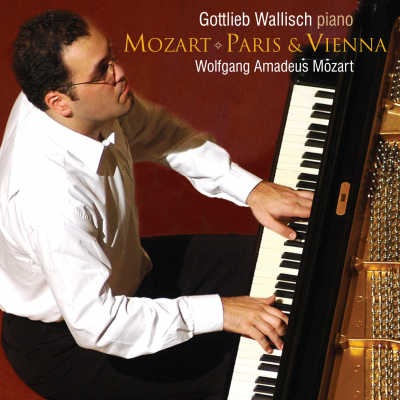
Photography by Wolfgang Werzowa
General management: M.A.M Management, Keith Hoare-Mayler
Live photos courtesy of Musical Evenings in St Donat, Zadar, Croatia
Steinway Model D # 493 845
Prepared by Leo H. Niedermeyer, Bayreuth