Produced by
Tim Oldham
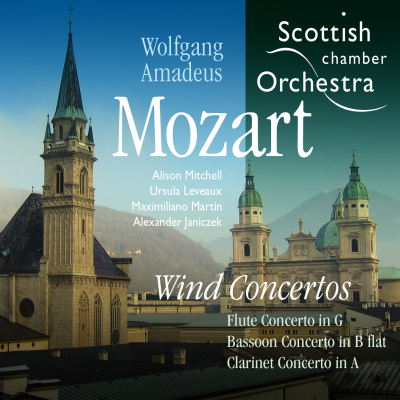
Recorded at the Usher Hall, Edinburgh, 5-7 June 2005
Engineered by Philip Hobbs
Post Production by Julia Thomas, Finesplice UK
Scottish Chamber Orchestra dir. Alexander Janiczek
Alison Mitchell – flute
Ursula Leveaux – bassoon
Maximiliano Martín - clarinet
The main theme in the Bassoon Concerto’s first movement, heard at the start and repeated by the solo on its first entry, centres on the bassoon’s most vocal tenor register, but with an initial motif of a bold descent through two octaves, designed to demonstrate the instrument’s wide range. This theme, in the Concerto’s opening bars, also brings into striking prominence the orchestra’s high-pitched B flat horns. The opening tutti already shows Mozart’s knack of presenting an extended series of contrasting ideas in such a way that the succession has the naturalness and spontaneity of a lively conversation. The end of the tutti is signalled by an emphatic unison rising scale, used as punctuation throughout the movement. In the middle section, where it appears most frequently, Mozart cleverly shortens this idea by degrees, so its appearance is never predictable. Another idea, which serves as second subject, is first heard as a single violin line with accompaniment. Instead of repeating this, the bassoon adds a counterpoint, only playing the original theme when it returns for a final time, when the violins play the counterpoint.
The Andante ma adagio (the unusual indication means “moving, but slowly”) takes the form of an aria, its soft, sensuous mood enhanced by the colour of muted strings. Again, the solo melodies concentrate on the bassoon’s plangent tenor register; occasional lower notes act as a dramatic reinforcement of the bass line, with a particularly memorable passage in which a series of these bass notes leads down to the bassoon’s very lowest pitch. In an era when many concerto slow movements were accompanied by strings alone, Mozart characteristically gives prominence to the oboes, not just in the tutti sections, but accompanying and in dialogue with the soloist.
The Bassoon Concerto’s Rondo begins with what sounds like a complete minuet played by the orchestra, and when the bassoon enters it’s with the beginning of a variation, soon, however, branching off into new ideas. Two further episodes, separated by shortened repeats of the orchestral minuet, are heard before the soloist gets a chance to play this main theme. It’s a crucial moment, preceded by a pause and a short cadenza, and gives the movement an extra dimension.
The Flute Concerto’s opening Allegro maestoso, with pointed, march-like rhythms, has a character that balances vivacity and stateliness. The first tutti is compact – just thirty bars – but this is the only concession to the requirement for a “small, short concerto”; these opening ideas are expanded by flute and orchestra to generous proportions. Indeed, the majestic style of the movement suggests that maybe Mozart had in mind the playing of the experienced professional, Wendling, rather than the amateur, Dejean.
The enchanted atmosphere of the Adagio recalls the mood and sonorities of the slow movement of the G major violin concerto of 1775 (K216); both pieces are in D major, with muted strings and flutes instead of oboes in the orchestra’s wind section. And in both movements the soloist projects a calm cantilena above an accompaniment that’s full of movement, and both feature a final return by the soloist after the cadenza to the opening melody. The solemn rising unison at the start, however, comes as a pre-echo of the great Adagio in the Gran Partita (K361) for wind instruments. The finale, another rondo in minuet tempo, brings the soloist in at the outset, contrasting the lightly accompanied solo statement of the theme with the sonorous orchestral version that follows. This same sequence recurs whenever the theme is repeated, but each time the flute finds a new way of ornamenting the melody, the decorations then repeated by the orchestra. In between, the episodes feature several brilliant solo passages, but Mozart is never content for long to leave the orchestra just to provide an accompaniment, delighting in bringing it forward to share in lively dialogue with the soloist.
In the 1779s, as we’ve seen, Mozart wrote concertos for a number of different instruments, but in the next decade we find him focussed more narrowly on his career as pianist/composer; the horn concertos written for Joseph Leutgeb are the only non-keyboard ones from the 1780s. In 1791, however, he turned to an instrument for which he had not previously written a concerto. For his friend, the court clarinettist Anton Stadler, he had already written two magnificent chamber works – the Trio with piano and viola, K498, and the Quintet, K581, plus unfinished drafts for two other quintets, and, of course, remarkable clarinet parts in operatic and orchestral music (where the two clarinettists would have been Stadler and his brother Johann). The Concerto was not composed for a standard clarinet in A but for an instrument Stadler had developed, extending the instrument’s lower range by four notes. The autograph score has not survived, and when the Concerto was first published after Mozart’s death, the solo part was adapted to suit an ordinary clarinet. For this performance, Maximiliano Martin plays a clarinet with the usual range, but has adapted the text of the first edition to make the best use of the clarinet’s lowest register.
In the thirteen years since the Flute Concerto, Mozart’s style had changed considerably. Instead of the slightly formal air of the earlier work’s opening, the Clarinet Concerto starts quietly and without seeking any dramatic effect. Indeed, the whole work can be seen as an essay in light and shade: in the solo part, between the bright upper register and the dark lower notes, with the two often opposing one another in dramatic fashion. Then there’s the contrast between the full, mellifluous orchestral sound and the intimate effect of many delicately scored passages for clarinet with upper strings, like the opening of the rondo finale. The characteristic sound of this concerto relates to its unusual orchestration, with pairs of flutes, bassoons and horns added to the strings – Mozart clearly didn’t want to oppose the clarinet’s sound to the more incisive tone of the oboe. The most glorious orchestral moments come in the Adagio, where the clarinet’s statements of the hymn-like theme are taken up by the orchestra, which plays the role of a chorus inspired by a solo singer. This Adagio’s simplicity of design, with regular phrase lengths that are only broken once or twice by the soloist, to avoid monotony and for expressive effect, contrasts with the elaborate, typically Mozartean play of different motifs in the outer movements.
Duncan Druce
19 February 2013
to
19 April 2013
Scotland
City Halls, Glasgow, Scotland, UK
Sco and SCO Chorus
13 March 2013
to
13 March 2013
Scotland
Younger Hall, St Andrews, Scotland, UK
Das Lied von der Erde
15 March 2013
to
15 March 2013
Scotland
City Halls, Glasgow, Scotland, UK
Das Lied von der Erde
16 March 2013
to
16 March 2013
Northern Ireland
Queen's Hall, Edinburgh, Scotland, UK
Das Lied von der Erde
20 March 2013
to
20 March 2013
Scotland
Younger Hall, St Andrews, Scotland, UK
Early Evening Concerts 2012/13 - March
04 April 2013
to
04 April 2013
Scotland
Usher Hall, Edinburgh, Scotland, UK
Ticciati conducts Berlioz
04 April 2013
to
04 April 2013
Scotland
Queen's Hall, Edinburgh, Scotland, UK
SCO
05 April 2013
to
05 April 2013
North America
The Granada Theatre, University of Calafornia Santa Barbara USA
USA Tour - Programme 1
05 April 2013
to
05 April 2013
Scotland
City Halls, Glasgow, Scotland, UK
Ticciati conducts Berlioz
07 April 2013
to
07 April 2013
North America
Walt Disney Concert Hall, Los Angeles USA
USA Tour - Programme 1 Santa Barbara
10 April 2013
to
10 April 2013
Scotland
Dumfries Easterbrook Hall, Dumfries, Scotland, UK
Sinfonia Concertante
11 April 2013
to
11 April 2013
Scotland
Queen's Hall, Edinburgh, Scotland, UK
Sinfonia Concertante
12 April 2013
to
12 April 2013
Scotland
City Halls, Glasgow, Scotland, UK
Sinfonia Concertante
12 April 2013
to
12 April 2013
North America
St Mark's United Methodist Church, Indialantic USA
USA Tour - Programme 1
14 April 2013
to
14 April 2013
Scotland
Eden Court Theatre, Inverness, Scotland, UK
Sinfonia Cocertante
18 April 2013
to
18 April 2013
Scotland
Queen's Hall, Edinburgh, Scotland, UK
Britten 100:1
19 April 2013
to
19 April 2013
Scotland
City Halls, Glasgow, Scotland, Uk
Britten 100:1
19 April 2013
to
19 April 2013
North America
Foellinger Great Hall - University of Illionois, Urbana-Champaign Illionois USA
USA Tour - Programme 1
21 April 2013
to
21 April 2013
Scotland
Queen's Hall, Edinburgh, Scotland, UK
Chamber Concert
24 April 2013
to
24 April 2013
Scotland
Younger Hall, St Andrews, Scotland, UK
Britten 100:11
26 April 2013
to
26 April 2013
Scotland
City Halls, Glasgow, Scotland, UK
Britten 100:11
27 April 2013
to
27 April 2013
Scotland
Queen's Hall, Edinburgh, Scotland, Uk
Britten 100:11
02 May 2013
to
02 May 2013
Scotland
Usher Hall, Edinburgh, Scotland, UK
Beethoven Seven
03 May 2013
to
03 May 2013
Scotland
City Halls, Glasgow, Scotland, UK
Beethoven Seven
09 May 2013
to
09 May 2013
Scotland
Queen's Hall, Edinburgh, Scotland, UK
Levin plays Mozart
10 May 2013
to
10 May 2013
Scotland
City Halls, Glasgow, Scotland, UK
Levin plays Mozart