Shopping Cart

0 Items in Cart
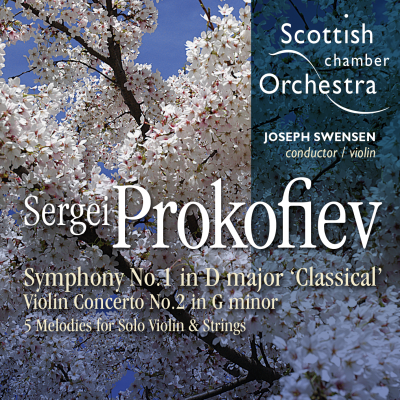
Prokofiev Violin Concerto

Scottish Chamber Orchestra

Prokofiev Violin Concerto

CKD 219 (Linn Records)
Bookmark and Share

Compact Disc

$22.00

Studio Master

FLAC 24bit 96kHz 1,050.7MB $24.00

Studio Master

WMA 24bit 96kHz 1,042.4MB $24.00

CD Quality

FLAC 16bit 44.1kHz 231.4MB $13.00

CD Quality

WMA 16bit 44.1kHz 227.1MB $13.00

MP3

MP3 320k 44.1kHz 125.6MB $11.00
Prices shown in US Dollars


Listen

Tracks: Listen and Download

Format
Track Time Listen
1
Symphony No. 1 in D Major 'Classical' Allegro

Symphony No. 1 in D Major 'Classical' Allegro

Composer Sergei Prokofiev
Conductor Joseph Swensen
4:28 Play $1.70
2
Symphony No. 1 in D Major 'Classical' Larghetto

Symphony No. 1 in D Major 'Classical' Larghetto

Composer Sergei Prokofiev
Conductor Joseph Swensen
4:08 Play $1.70
3
Symphony No. 1 in D Major 'Classical' Gavotta: Non troppo allegro

Symphony No. 1 in D Major 'Classical' Gavotta: Non troppo allegro

Composer Sergei Prokofiev
Conductor Joseph Swensen
1:36 Play $1.70
4
Symphony No. 1 in D Major 'Classical' Finale: Molto vivace

Symphony No. 1 in D Major 'Classical' Finale: Molto vivace

Composer Sergei Prokofiev
Conductor Joseph Swensen
3:53 Play $1.70
5
Violin Concerto No. 2 in G minor Allegro Moderato

Violin Concerto No. 2 in G minor Allegro Moderato

Composer Sergei Prokofiev
Conductor Joseph Swensen
Soloist Joseph Swensen - violin
11:14 Play $5.10
6
Violin Concerto No. 2 in G minor Andante assai

Violin Concerto No. 2 in G minor Andante assai

Composer Sergei Prokofiev
Conductor Joseph Swensen
Soloist Joseph Swensen - violin
10:22 Play $5.10
7
Violin Concerto No. 2 in G minor Allegro ben marcarto

Violin Concerto No. 2 in G minor Allegro ben marcarto

Composer Sergei Prokofiev
Conductor Joseph Swensen
Soloist Joseph Swensen - violin
6:25 Play $3.40
8
Five Melodies for Solo Violin and Strings Andante

Five Melodies for Solo Violin and Strings Andante

Composer Sergei Prokofiev
Conductor Joseph Swensen
Soloist Joseph Swensen - violin
Arranger Joseph Swensen
2:13 Play $1.70
9
Five Melodies for Solo Violin and Strings Lento non troppo

Five Melodies for Solo Violin and Strings Lento non troppo

Composer Sergei Prokofiev
Conductor Joseph Swensen
Soloist Joseph Swensen - violin
Arranger Joseph Swensen
2:19 Play $1.70
10
Five Melodies for Solo Violin and Strings Animato, ma non allegro

Five Melodies for Solo Violin and Strings Animato, ma non allegro

Composer Sergei Prokofiev
Conductor Joseph Swensen
Soloist Joseph Swensen - violin
Arranger Joseph Swensen
3:19 Play $1.70
11
Five Melodies for Solo Violin and Strings Allegretto leggero et scherzando

Five Melodies for Solo Violin and Strings Allegretto leggero et scherzando

Composer Sergei Prokofiev
Conductor Joseph Swensen
Soloist Joseph Swensen - violin
Arranger Joseph Swensen
1:12 Play $1.70
12
Five Melodies for Solo Violin and Strings Andante non troppo

Five Melodies for Solo Violin and Strings Andante non troppo

Composer Sergei Prokofiev
Conductor Joseph Swensen
Soloist Joseph Swensen - violin
Arranger Joseph Swensen
2:56 Play $1.70
Total Running Time 54 minutes Purchase all tracks 
$13.00 
Prices shown in US Dollars

Linn Records continues its successful partnership with the SCO, with this, the sixth release in the series (the fourth with conductor Joseph Swensen).

"Really, this is exceptional by any standard." Artistic Quality 10/Sound Quality 10 ClassicsToday.com

The SACD layer is both 5.1 channel and 2-channel. The Studio Master files are 96kHz / 24-bit.

Download includes - cover art, booklet
Joseph Swensen

Joseph Swensen

Joseph Swensen was principal conductor of the Scottish Chamber Orchestra from 1996-2005.
profile & recordings >>

Produced by Andrew Keener

Recorded at the Usher Hall, Edinburgh, UK 15 & 16 March 2003
Engineered by Philip Hobbs & Calum Malcolm
Post Production by Julia Thomas at Finesplice
Cover Photo by John Haxby
Photo of Joseph Swensen by Douglas Robertson

Violin Concerto No. 2 is perhaps the best-known and loved of Prokofiev’s violin works. Composed in 1935, just before Prokofiev ended his 17 years of self-imposed exile from post-Revolutionary Russia, it is one of his finest essays in the style of ‘new simplicity’ he had been cultivating from the early 1930s. Fearing that his inspiration was drying up after his flirtation with the modish styles of such composers as Honegger, Hindemith and above all Stravinsky, Prokofiev had consciously clarified his harmonic language and given primacy to his melodic invention. The cheeky tunefulness of Lieutenant Kizhe was one striking result, and it was a year after arranging a suite from this film score that Prokofiev composed his Second Concerto for the French-Belgian violinist Robert Soetens. Soetens had taken part in the premiere of Prokofiev’s Sonata for two violins in 1932, partnering Samuel Dushkin who had just received a Violin Concerto from Stravinsky. It therefore seemed appropriate that Soetens should receive a concerto from Stravinsky’s composing rival, who gave him a year’s exclusive right to perform the work.

In contrast to the lush orchestral forces of Concerto No. 1, the Second is scored with Classical restraint: just a pair each of flutes, oboes, clarinets, bassoons, horns and trumpets, as well as strings (a line-up, save for the percussion, identical to that of Prokofiev’s ‘Classical’ Symphony). Even the ‘exotic’ instruments which reside in the percussion department are ones Mozart might have recognised, if not within a symphonic score: side drum, triangle, castanets (possibly in salutation to its projected Madrid premiere), and - a key player in this score - bass drum. The soloist launches the Concerto with an unaccompanied, brooding melody, out of which much of the movement’s material is to be woven. This eventually elicits a stark reply from muted violas and basses playing in unison and a gradual build up of entries from the rest of the orchestra, though textures remain lean and almost severely contrapuntal until the arrival of the soloist’s rich-toned, lyrical second theme, echoed by horns. This offers only temporary respite, though, as the development section becomes increasingly hectic, the soloist’s rapidly weaving passages suggesting fearful flight, and the movement finally ends with several decisive cadences underscored by the thunk of the bass drum like so many closing doors. With the slow movement comes one of Prokofiev’s most celebrated long-arching melodies, cast by the soloist initially over a simple arpeggio accompaniment played, with almost imbecilic-sounding precision, by pizzicato strings and staccato clarinet. The finale starts as a vigorous waltz, but the bass drum, whose sinister presence has been felt in the first movement, increasingly takes charge, its impatient pounding dislocating the waltz rhythm and harrying the soloist to the concerto’s final sardonic cadence.

Prokofiev, of course, had had a number of successes in the West, among them the Five Melodies. These were composed in their original form early in 1921 when Prokofiev was touring California. In these hauntingly beautiful pieces, originally intended as vocalises for the Russian mezzo-soprano and one time lover of Rachmaninov, Nina Koshetz, one senses his relish of the ‘marvellous weather and smiling people’ he had encountered, touched with a certain wistfulness as he perhaps recalled his then lost homeland. Yet it was only when the Melodies were arranged in 1925 for the violin’s hyper-expressive powers that their full poignant lyricism was revealed. These arrangements were made with the assistance of the Polish violinist, Paul Kochanski, a friend and regular performing partner of Szymanowski, whose playing in pre-Revolutionary Russia had so inspired Prokofiev when he composed his enchantingly lyrical First Violin Concerto. Reunited in America, Prokofiev and Kochanski became firm friends, and Prokofiev dedicated three of the five Melodies - the first, third and fourth - to Kochanski. The second piece is dedicated to another violinist, Cecilia Hansen, wife of one of Prokofiev’s pianist friends from his days at the St Petersburg Conservatory; and the last is dedicated to Szigati, who did so much to champion Prokofiev’s First Violin Concerto, securing its first recording (with Beecham conducting) even against the resistance of the directors of Columbia Records to whom he was contracted.

Composed almost concurrently with the First Violin Concerto in 1917 was Prokofiev’s First Symphony – effectively, as one Moscow professor has impishly suggested, his belated graduation-style exercise to write an orthodox ‘Classical’ symphony. Prokofiev had graduated from the St Petersburg Conservatory in 1914, where he had studied conducting under Nikolay Tcherepnin. Tcherepnin had a particular enthusiasm for such late eighteenth-century Classical composers as Mozart and Haydn – this at a time when Haydn in particular was scarcely performed. During his conducting classes, Tcherepnin would sit by Prokofiev to point out felicities in their scoring - ‘Now listen to that delightful little bassoon there!’ Prokofiev, at that time an enthusiast for Skriabin’s febrile harmonies, found the Classical composers’ clean-cut, orderly style and economical yet piquant orchestration a revelation. Although it seems an early version of the third movement Gavotte was composed before his graduation, it was only after the February Revolution of 1917 that he finally completed his Symphony No. 1. This was partly as an exercise in writing music away from the piano to try to discover ‘more transparent orchestral colours’. Prokofiev not only succeeded in this, but discovered a balletic grace quite unlike his galumphing first attempt at ballet, Ala i Lolli, abandoned in 1915. He himself named his symphony ‘Classical’ in order to “tease the geese”. Indeed, it lives up to its name with a conventional four-movement symphonic scheme and its textbook-style sonata form for the first movement, with clearly punctuated exposition and development sections, then recapitulation. Prokofiev spices these conventions with individual touches of his own, playing harmonic sleights of hand with sudden shifts into alien keys – like the unnatural perspectives of an Escher drawing – and replacing the usual minuet and trio third movement with his favoured gavotte (its trio section given a pastoral flavour by its musette-style bass drone). However it is the music’s freshness, succinctness and unforced joie de vivre which has made Prokofiev’s affectionate pastiche of Haydn’s manner an enduring favourite.

Be the first to add a customer recommendation.

Please Login or Register to write a customer recommendation.
Classic FM Magazine
4 Stars
strong and classy solo playing
more >>

BBC Music Magazine
4 Stars
the Five Melodies is the real reason for enthusiasts to search out this disc
more >>

ClassicsToday.com
5 Stars
this is exceptional by any standard
more >>

Atlanta Audio Society
simply stunning
more >>

International Record Review
This is worth investigating
more >>

The Dominion Post
marvellously intense...beautifully played
more >>

Inverness Courier
a sparkling account
more >>

The Scotsman
5 Stars
a blisteringly clear and effervescent performance
more >>

03 January 2012
Scotland
Dumfries Easterbrook Hall, Dumfries
New Year in Vienna


There is no better way to welcome in 2012 than with an uplifting Viennese New Year concert featuring favourite waltzes and polkas from the Strauss Family.     

A night in Old Vienna, including:

J STRAUSS: Overture, Die Fledermaus
J STRAUSS II: Kunstlerleben (Artists' Life) Waltz
LEHAR: Gold and Silver Waltz
J STRAUSS II: Champagne Polka
   

Nicholas McGegan, conductor

Elena Xanthoudakis, soprano

7pm


04 January 2012
Scotland
Ayr Town Hall, Ayr
New Year in Vienna


There is no better way to welcome in 2012 than with an uplifting Viennese New Year concert featuring favourite waltzes and polkas from the Strauss Family.     

A night in Old Vienna, including:

J STRAUSS: Overture, Die Fledermaus
J STRAUSS II: Kunstlerleben (Artists' Life) Waltz
LEHAR: Gold and Silver Waltz
J STRAUSS II: Champagne Polka
   

Nicholas McGegan, conductor

Elena Xanthoudakis, soprano

7pm


05 January 2012
Scotland
Perth Concert Hall, Perth
New Year in Vienna


There is no better way to welcome in 2012 than with an uplifting Viennese New Year concert featuring favourite waltzes and polkas from the Strauss Family.     

A night in Old Vienna, including:

J STRAUSS: Overture, Die Fledermaus
J STRAUSS II: Kunstlerleben (Artists' Life) Waltz
LEHAR: Gold and Silver Waltz
J STRAUSS II: Champagne Polka
   

Nicholas McGegan, conductor

Elena Xanthoudakis, soprano

7pm


17 January 2012 to 17 January 2012
Scotland
St Cuthberts Parish Church (6pm), Edinburgh, Scotland
CL@6: A Day In Symphonies

27 January 2012
Scotland
City Halls, Glasgow
Aimard Plays Brahms
     

Pierre Laurent-Aimard perfoms Brahms' mighty Piano Concerto No 2, in a concert also featuring music by Haydn and Ligeti.     

Programme:

HAYDN: Symphony No.22 in Eb 'Philosopher'
LIGETI: Chamber Concerto for 13 Instruments
BRAHMS: Piano Concerto No.2
       

Robin Ticciati, conductor

Pierre-Laurent Aimard, piano

7.30pm


02 February 2012
Scotland
Queen's Hall, Edinburgh
Langree Conducts Beethoven


Louis Langrée directs the SCO and a world-class line-up of soloists in Beethoven's magnificent Mass in C.

Programme:

GLUCK: Overture, Iphigenie en Aulide
BEETHOVEN: Symphony No.4
BEETHOVEN: Mass in C
     

Louis Langree, conductor

Elena Xanthoudakis, soprano

Jurgita Adamonyte, mezzo soprano

Andrew Staples, tenor

Alastair Miles, bass

SCO Chorus

7.30pm


03 February 2012
Scotland
City Halls, Glasgow
Langree Conducts Beethoven
    

Louis Langrée directs the SCO and a world-class line-up of soloists in Beethoven's magnificent Mass in C.

Programme:

GLUCK: Overture, Iphigenie en Aulide
BEETHOVEN: Symphony No.4
BEETHOVEN: Mass in C
     

Louis Langree, conductor

Elena Xanthoudakis, soprano

Jurgita Adamonyte, mezzo soprano

Andrew Staples, tenor

Alastair Miles, bass

SCO Chorus

7.30pm


05 February 2012
Scotland
Queen's Hall, Edinburgh
Chamber Concert


Pianist Llyr Williams is joined by SCO Principals, Maximiliano Martín and Jane Atkins, for a Sunday afternoon treat of music by Brahms and Kurtág.     

Programme:

BRAHMS: Sonata Op 120 No.1 in F minor
BRAHMS: Intermezzi
KURTAG: Hommage a R. Schumann
BRAHMS: Sonata Op 120 No.2 in Eb
    

Llyr Williams, piano

Maximiliano Martin, clarinet

Jane Atkins, viola

3pm


09 February 2012
Scotland
Usher Hall, Edinburgh
Emperor and Eroica


Andrew Manze conducts two masterworks by Beethoven, with Llyr Williams the soloist in Beethoven's Piano Concerto No.5 

Programme:

CHERUBINI: Overture, Demophoon
BEETHOVEN: Piano Concerto No.5 'Emperor'
BEETHOVEN: Symphony No.3 'Eroica'


Andrew Manze, conductor

Llyr Williams, piano

7.30pm 


10 February 2012
Scotland
City Halls, Glasgow
Emperor and Eroica


Andrew Manze conducts two masterworks by Beethoven, with Llyr Williams the soloist in Beethoven's Piano Concerto No.5 

Programme:

CHERUBINI: Overture, Demophoon
BEETHOVEN: Piano Concerto No.5 'Emperor'
BEETHOVEN: Symphony No.3 'Eroica'


11 February 2012 to 11 February 2015
Scotland

Aberdeen Music Hall, Aberdeen,Scotland
Emperor and Eroica
Union Street Aberdeen AB10 1QS

23 February 2012 to 23 February 2012
Scotland
City Halls, Glasgow, Scotland
Serenade
Candleriggs, Glasgow G1 1NQ

28 February 2012 to 28 February 2012
Scotland
St Cuthberts Parish Church, Edinburgh, Scotland
CL@6: A Lark Ascending
Lothian Road, Edinburgh EH1 2EP - 6PM

29 February 2012 to 29 February 2012
Africa
Younger Hall, St Andrews, Scotland
Early Evening Concert
North SAtreet, St Andrews KY16 9JA - 5.30PM

12 April 2012 to 12 April 2012
Scotland
Queen's Hall, Edinburgh, Scotland
Baroque Greats

13 April 2012 to 13 April 2012
Scotland
City Halls, Glasgow Scotland
Baroque Greats
Candleriggs, Glasgow G1 1NQ

20 April 2012 to 20 April 2012
Scotland
City Halls, Glasgow, Scotland
A Cold Spring
Candleriggs, Glasgow G1 1NQ

25 April 2012 to 25 April 2012
Scotland
Ayr Town Hall, Ayr, Scotland
Benedetti: Vivaldi's Four Seasons

26 April 2012 to 26 April 2012
Scotland
Usher Hall, Edinburgh, Scotland
Benedetti: Vivaldi's Four Seasons

27 April 2012 to 27 April 2012
Scotland
City Halls, Glasgow, Scotland
Benedetti: Vivaldi's Four Seasons
Candleriggs, Glasgow G1 1NQ

03 May 2012 to 03 May 2012
Scotland
Queen's Halls, Edinbugh, Scotland
Biss PLays Mozart

04 May 2012 to 04 May 2012
Scotland
City Halls, Glasgow, Scotland
Biss Plays Mozart

10 May 2012 to 10 May 2012
Scotland
Usher Hall, Edinburgh, Scotland
Beethoven's Choral Symphony

11 May 2012 to 11 May 2012
Scotland
City Halls, Glasgow, Scotland
Beethoven's Choral Symphony