ICMA Nominee
Best Early Music Album
2013 Awards
Magnificat, who specialise in the restoration and performance of neglected choral masterpieces of the 16th and 17th centuries, embraces the composer's rich, contrapuntal Renaissance style. The lush textures and colours for which Rogier is renowned are highlighted by the musicians and singers in this historically-informed performance that is bursting with vitality and energy. The inclusion of cornetts and sackbuts adds a noble and grandious sound to the performance and were an important tool for composers in creating a colourful timbre in the 16th and 17th centuries.
Booklet Notes:
The practice of borrowing material from one work as the inspiration or source of musical ideas for another has a long history. The technique burgeoned during the sixteenth century, when the range of material borrowed included plainsong melodies, secular songs, solmisation syllables, and even entire works. In sixteenth-century Spain, many composers displayed their greatest skill in settings of the Ordinary of the Mass, often embracing this practice of ‘parodying' musical ideas. Cristóbal de Morales, for example, composed twenty-one parody masses, Francisco Guerrero used pre-existing material in each of his eighteen masses, and Tomás Luis de Victoria based all but one of his twenty masses on musical ideas either from his own motets or from polyphonic pieces by others.
Spanish Renaissance composers displayed a clear predilection for Franco-Flemish models for their parody masses: motets by Mouton, Verdelot, Richafort and Gombert all received this form of homage. The eminence and influence of Northern European musicians in Spain was a product of the political and geographical dominance of the Hapsburg Empire and its great patronage of music and musicians. Following in the footsteps of his father, Emperor Charles V, King Philip II of Spain maintained a significant musical household at his court in Madrid, where Flemish musicians figured prominently in a long line of chapel-masters and singers.
Philippe Rogier (c.1561-1596) was one of many Flemish choristers chosen to sing at the Spanish royal court, where he would have encountered musicians from the Franco-Flemish tradition, sung their music and been taught by them. King Philip II appointed him maestro di capilla in 1588 and Rogier worked at court until his untimely death in 1596 at the age of 35. He was a prolific and talented composer with over 250 works to his name, though only about one-fifth of these have survived in two main sources: a book of motets published in Naples in 1595 and a book of masses (the Missae Sex) published posthumously in Madrid in 1598. Rogier was clearly well-versed in the parody mass tradition, as several of his extant settings have roots in other works: the Missa Ego sum qui sum is based on a motet by Gombert (recorded by Magnificat on Linn Records CKD 109); the Missa Domine in virtute tua derives its material from a motet by Palestrina (recorded by Magnificat on Linn Records CKD 348); the model for Rogier's Missa Dirige gressos meos is a motet by Crecquillon, and the Missa Inclina Domine is based on a motet by Morales. Missa Inclita stirps Jesse, recorded for the first time on this album, takes its thematic material from a motet by Jacobus Clemens (also known as Clemens non Papa).
Clemens' Inclita stirps Jesse was published in Augsburg in 1549 in the second volume of Cantiones selectissimae for four voices. The motet is for the Feast of St. Anne, Mother of the Virgin Mary, and is in two parts, each ending with an identical Alleluia. Clemens' musical setting is appealingly simple; the writing is motivic in character, using compact melodies of quite limited range. The first part develops stepwise rising and falling figures, while the second part opens with a lilting, rocking motif.
It was common for composers who borrowed melodic material from a model to present it in the same order in their new piece, and Rogier can be seen to follow this practice in the Missa Inclita stirps Jesse. Thus the first Kyrie eleison derives its melodic material from the opening of Clemens' motet, and the second Kyrie features the rocking motif from the second part of the motet. Rogier follows the same approach in setting the longer movements of the Ordinary of the Mass, the Gloria and the Credo. The Gloria, for example, opens with the same melodic material as the Kyrie, and music from the second part of the motet is introduced at ‘Qui tollis peccata mundi'. A striking harmonic change highlights the phrase ‘Suscipe deprecationem', and the movement concludes with an exhilarating sequential passage, a feature also found at the end of the Credo of this Mass, and in the Missa Ego sum qui sum. Here Rogier seems to be looking forward to an idiom propelled as much by harmonic progression as by polyphonic invention. This emphasis is again evident in the Credo, especially at the words ‘Et incarnatus est', presented in a more static musical style, and with the introduction of unexpected harmonic colour at ‘et homo factus est'.
The Sanctus is a beautifully written paean of overlapping rising and falling phrases derived from the opening of Clemens' motet. ‘Pleni sunt caeli' has a dance-like quality involving sequences of suspensions, leading to a lively ‘Hosanna in excelsis' in triple time with cross rhythms, shifting accents and use of running quaver figures derived from the motet's Alleluias.
Although we do not know the occasion for which Rogier wrote the Missa Inclita stirps Jesse, it was composed no later than 1591, when the court copyist, Isaac Bertout, listed it among the works by Rogier that he had copied ‘en forma grande, notas cuadrades, son viente y ocho pliegos' (in large format, square notes, 28 pages). In 1594, the same copyist was paid 54 reales for ‘Una misa a cuatro vozes en forma grande, Phelipus Secundus Rex Hispaniae, en forma grande, de Phelipe Rogier' (a mass for four voices in large format, [entitled] Philip II King of Spain, in large format, by Philippe Rogier).1 Unlike the Missa Inclita stirps Jesse, Rogier's Missa Philippus Secundus Rex Hispaniae uses melodic material not from a pre-existing work, but from a musical cypher turned into a cantus firmus. The Mass is based on notes derived from the solmisation syllables of the vowels in the King's title, Philippus Secundus Rex Hispaniae.
Sometimes referred to as a soggetto cavato (an abbreviation of soggetto cavato dalle vocali di queste parole - a melody created from the vowels of these words), the earliest and best-known example of this technique is Josquin's Missa Hercules Dux Ferrariae, composed for Duke Ercole d'Este I of Ferrara in the 1480s or early 1500s. Another example, somewhat nearer home, was Bartolome de Escobedo's Missa Philippus Rex Hispaniae, also addressed to King Philip II of Spain, and thought to date from the mid-1550s. Both of these settings cloak their dedicatory melodies with complex structures and musical devices, and it is very likely that Rogier would have known both works. Whether Rogier's Mass was ever used liturgically, King Philip was pleased enough with it to support its publication: it is the first work in the Missae Sex of 1598.
Rogier uses his musical cypher in cantus firmus fashion, repeating it no less than 29 times in the course of the mass, presenting it in long notes in the tenor part. He favours groups of three repetitions per movement or section, often using a higher pitch for each occurrence. This effectively limits Rogier to composing for just three moving parts, but his music nevertheless displays enormous variety of texture and pace. Perhaps reflecting Josquin's contrapuntal expertise, Rogier also uses his melody in reverse (a technique known as cancrizans or retrograde), and employs augmentation and diminution (making the note lengths longer or shorter), for example in the Hosanna in excelsis; he also follows a well-established precedent by adding two extra voices to the texture in the Agnus Dei.
Unlike Josquin (and Escobedo), Rogier does not use the text of the Ordinary of the Mass for his cantus firmus part. Except in the Benedictus, he retains the dedicatory ‘Philippus Secundus' text throughout, even when the notes are sung in retrograde order. Rogier was fond of developing motivic ideas, often in sequential passages, and the soggetto cavato provided him with a wealth of material. Rising scalar passages from the soggetto and short musical patterns, such as the descending countersubject heard at the start of the mass, blossom into significance at intervals throughout the work. A particularly exciting climax builds at the end of the Credo, with pairs of voices dancing in duple time round the final statement of the theme, which is heard in long, triple-time notes.
In contrast with the more forward-looking polychoral works featured in Magnificat's previous album of music by Rogier (on Linn Records CKD 348), all the works performed here make reference to compositional techniques established by previous generations. There are surely echoes of Josquin in the soggetto of Missa Philippus Secundus Rex Hispaniae, and Rogier pays homage to Clemens and the Franco-Flemish style of the mid-16th century in Missa Inclita stirps Jesse. In his six-part motet Da pacem, Domine (heard here in an instrumental performance), Rogier makes use of a traditional plainchant melody as a cantus firmus. A further connection is found in music by the distinguished organist and composer, Antonio de Cabezón (1510-1566), employed by Queen Isabella, Philip II's mother, and after her death, by Philip himself. Two pieces of organ music by Cabezón are included on this recording: one, following the theme of cantus firmus treatments, is an elaborate solo based on the Marian hymn Ave maris stella, while the other continues the connection with Clemens. It is entitled Cancion francesa glosada (‘ornamented'), and its model is the chanson by Clemens Jamais en ce monde n'auray regret, published in Le huitiesme livre de chansons à quatre parties (Antwerp, 1545).
© Philip Cave, 2011
1 ‘En forma grande' (written twice) may refer to the large choirbooks which were placed on a central music desk and shared by the singers: some as large as 48 x 30 inches (closed) and weighing 35-40 lbs.
Recording Information:
Recorded at St George's Chesterton, Cambridge, UK from the 21st-23rd of February 2011
Produced and engineered by Philip Hobbs
Post-production by Julia Thomas, Finesplice, UK
Design by John Haxby
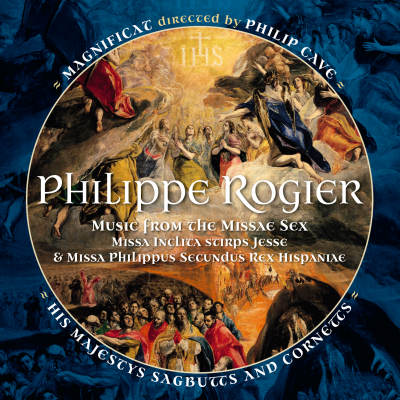
Cover image: The Adoration of the Name of Jesus, c.1578 (oil on canvas) by El Greco (1541-1614)
Monasterio de El Escorial, Spain / Giraudon / The Bridgeman Art Library